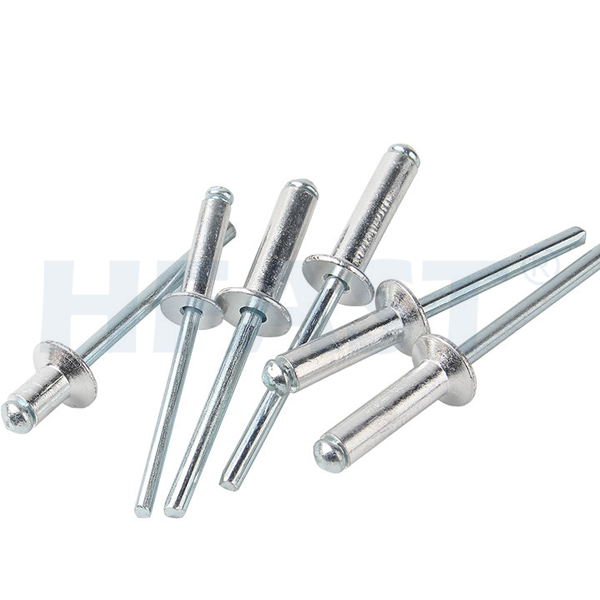
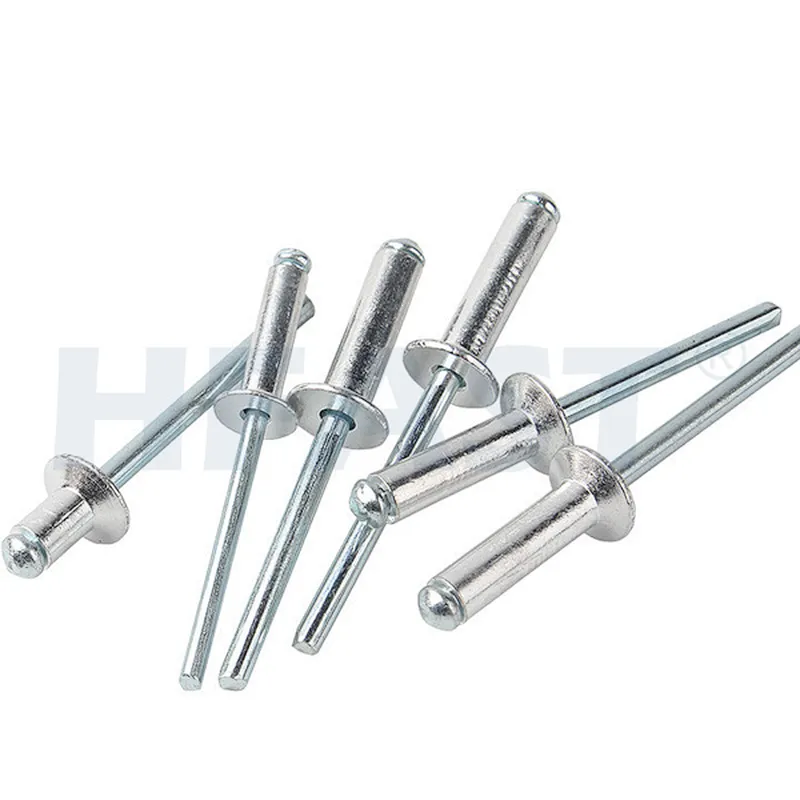

Blind rivet (commonly known by the brand name Pop Rivet) is a mechanical fastener used to join two or more materials together from one side only. This is the origin of the name"blind"—you don't need access to the back or"blind"side of the workpiece to install it. This makes them incredibly versatile for applications where the rear of the joint is inaccessible, such as in hollow structures, sheet metal assemblies, or enclosed boxes.
A standard blind rivet consists of two main parts:
Rivet Body (or Shell): This is the hollow, cylindrical body with a flange (head) on one end.
Mandrel (or Stem): This is a solid pin that runs through the center of the rivet body. One end of the mandrel has an enlarged, rounded head that sits in the rivet body's barrel, and the other end is designed to be gripped by the rivet tool.
Sizes and Specifications
Blind rivets are specified by two key dimensions and material.
1. Diameter (Grip Range) - The"Size"
The diameter refers to the thickness of the rivet body's shaft. Common imperial and metric sizes include:
Imperial (Inches): 3/32"(0.094"), 1/8"(0.125"), 5/32"(0.156"), 3/16"(0.187"), 1/4"(0.250")
Metric (Millimeters): 2.4mm, 3mm, 3.2mm, 4mm, 4.8mm, 5mm, 6mm, 6.4mm
The rule of thumb: Use a larger diameter rivet for thicker or stronger materials and for higher strength requirements.
2. Grip Range
This is the total combined thickness of the materials you are joining that the rivet is designed to hold. It is the most critical dimension to get right.
Rivets are sold with a specified minimum and maximum grip range (e.g., 0.020"to 0.125").
If the material is thinner than the minimum grip, the rivet may not form properly.
If the material is thicker than the maximum grip, the mandrel may break before the rivet is fully set, resulting in a loose joint.
Example: A rivet labeled as 1/8"diameter, 1/4"grip is ideal for joining materials that, when stacked, are about 1/4"thick.