

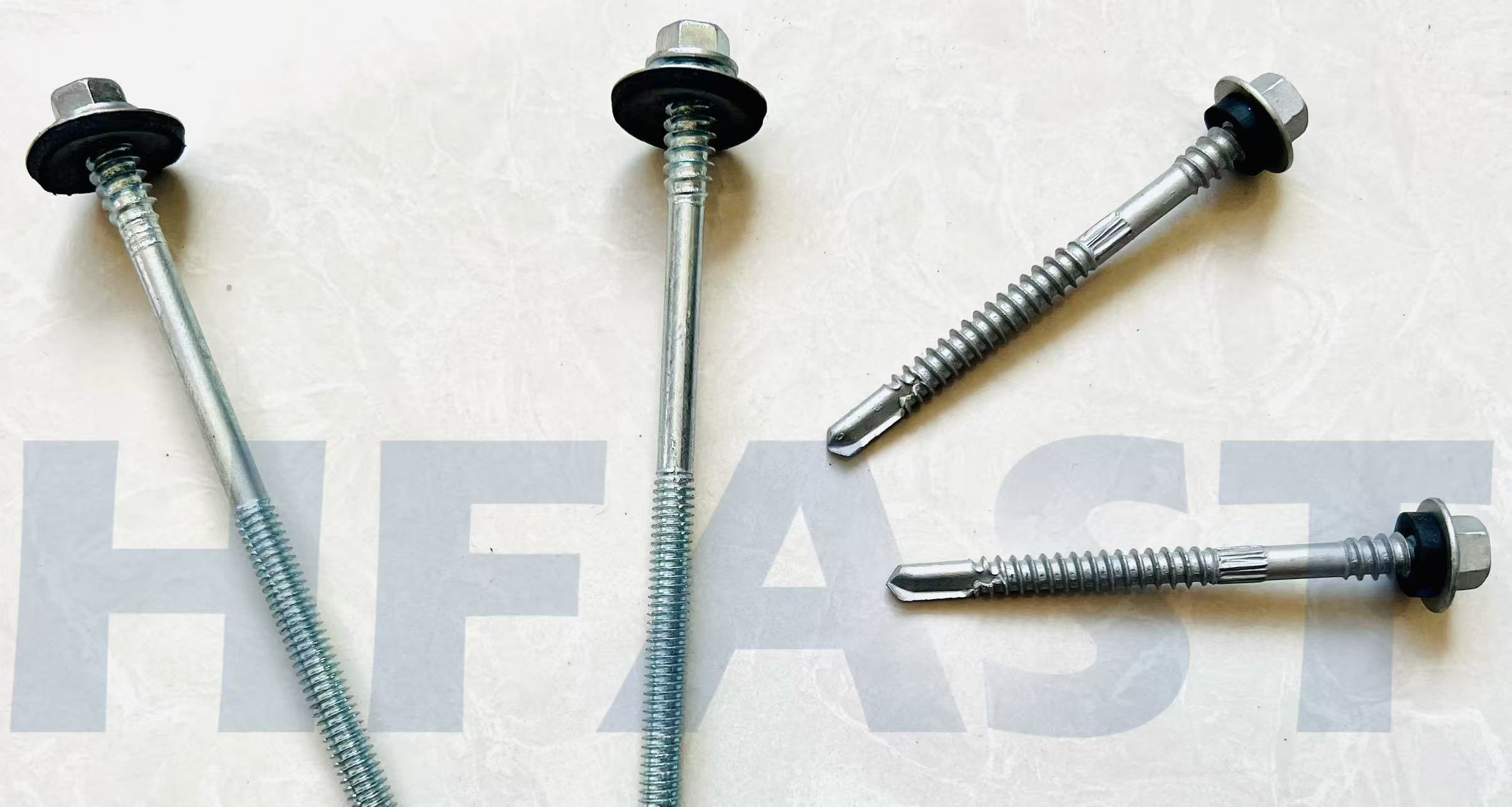
Double‑Thread Self‑Drilling Screws: Design, Advantages & Practical Guide
Double‑thread (twin‑lead) self‑drilling screws stand out among construction fasteners for their dual‑helix thread profile. Unlike conventional single‑thread screws, they feature two parallel starting threads running along the shank, paired with a functional drill‑point tip for one‑step drilling, tapping and fastening. This well‑optimized geometry brings tangible improvements in installation speed, holding power and anti‑loosening performance, widely trusted in light‑steel construction, metal cladding and composite assembly projects.
Core Structural Features
The most distinctive feature is its double‑start thread design. Two independent helix threads advance simultaneously as the screw rotates. With each full rotation, the screw travels twice the axial distance compared to single‑thread counterparts, cutting driving time and lowering heat build‑up during penetration.
Matched with a heat‑treated drill point, it removes the need for pre‑drilled pilot holes. The double‑thread increases total thread engagement area against substrates. Available head options include hex‑flange, wafer head, pan head and bugle head to fit different surface‑finish requirements. Common surface treatments cover yellow zinc, blue‑white zinc and dacromet to deliver basic‑to‑medium corrosion resistance for indoor and outdoor environments.
Key Performance Benefits
- Faster installation efficiency Dual‑thread geometry enables faster feed‑in per revolution. Installers spend less time on each fastener, greatly improving overall productivity for large‑volume site jobs and reducing labor costs.
- Enhanced holding & pull‑out resistance Double threads create more contact points within the base material. Load forces are distributed across larger thread surfaces, delivering superior pull‑out strength. Connections are less likely to fail under vibration or dynamic load compared to standard single‑thread screws.
- Lower driving torque Optimized twin‑lead thread reduces resistance while driving. It puts less strain on power tools and minimizes the risk of screw breakage or thread stripping during installation on thin steel sheets or timber‑metal joints.
- Reliable anti‑vibration performance Interleaved double threads form multi‑point bite inside substrates. This effect effectively resists loosening caused by mechanical vibration, making it suitable for structures exposed to continuous shaking or wind load.
- Broad material compatibility It performs well for steel‑to‑steel, steel‑to‑wood and metal‑to‑composite connections. It can be combined with sealing washers for metal roof and wall panel fastening applications.
Typical Application Scenarios
- Light‑gauge steel framing: light‑steel keels, partition frames and prefabricated building components
- Metal roofing & wall cladding: color steel sheets, metal facade panels fastened to purlins
- Timber‑metal composite structures: joining wooden members with metal brackets
- HVAC ductwork, warehouse enclosures, container accessories and metal cabinet assembly
- General‑purpose projects requiring high installation speed and vibration‑resistant connections
Practical Selection Tips
First, confirm the drill‑point capacity matches the actual thickness of your steel substrate. Exceeding the screw’s drilling capacity will lead to incomplete penetration or bit damage. Second, choose proper surface plating according to service conditions: yellow or blue‑white zinc for normal atmospheric environments; upgrade to higher‑grade coating for coastal high‑salt‑fog areas. Third, select correct head style: wafer head for low‑profile neat surface; hex‑flange head for heavy‑duty fastening with sealing washer. Always ensure sufficient thread engagement after full penetration to secure stable clamping force.
Summary
Double‑thread self‑drilling screws combine fast‑feed thread geometry with proven self‑drilling capability. It balances high‑speed installation, strong holding force and anti‑vibration performance. For contractors and fabricators working on light‑steel and metal‑cladding projects, double‑thread screws remain a cost‑effective, high‑performance fastening solution.
About US
Hebei Hengcheng Fastener Co., Ltd
Hebei Hengcheng Fastener Co., Ltd was established in Hebei Yongnian in 1998, specializing in the productions and sales of fasteners including self-drilling screw, self-tapping screw, drywall screw, chipboard screw and customized screws. The company covers an area of 70,000 square meters with about 150 staff at present, and among which there are over 30 senior technicians and 20 salesmen. To guarantee the quality, the company applies the world-advanced facilities for production including machines of cold forging, pinch pointing, threading, wire drawing, annealing, heat treatment and other ancillary equipment. With 24 years’ development, the company becomes one of the largest fastener manufacturer in north China.
The company has passed the ISO9001:2015 international quality system certification. The trade mark “HF” is honored “Well-Known Trade Mark of Hebei Province”, meanwhile, the product is honored “Famous-Brand Product” by the Authority. The company is an export-oriented enterprise and the products are exported to more than 80 countries and regions, such as South Korea, Japan, America, Southeast Asia, Middle East and Africa and enjoyed a good reputation among customers. The company is dedicated to supply the best products and services to customers and would like to express sincere invitation to friends from all over the world.

 、
、